Seven Steps to Draw People in Need to Non-profits Providing Help

Snowflake Consulting • February 22, 2024

How to Use Relationship Marketing to Attract New Clients

A volunteer serves food in a soup kitchen

In our last post, we explained why Relationship Marketing (RM) is essential to drawing new non-profit clients, including those who are under-served and/or hard to reach. Although it’s very effective, RM isn’t just about donors. It can also be applied to accomplish more mission-oriented goals, ultimately increasing the impact non-profits have on their communities. At its core, RM is about learning about audiences, personalizing outreach, and tailoring the client experience (CX) to key segments to inform, influence, and deliver what people need and want


Our experiences with non-profits shows they’re often missing large swaths of their eligible populations. While they make significant impacts on the lives of those they’re helping, there are so many more who can benefit from but aren’t using them. We’ve routinely seen non-profits serving as little as ten percent of the people who could and should be taking advantage of their services .The “missing” can comprise thousands of uncaptured potential clients, so there is plenty of demand. Opportunities to make even greater impacts are significant.


What’s causes these “gaps?” There are many reasons. For a lot of non-profits, people who could really use the help they’re not coming to get may, for example:


  • Be unaware of what’s available and the organizations that provide it


  • Have difficulties accessing them, for a variety of reasons


  • Feel insecure about approaching and engaging with providers


  • Are influenced by cultural norms that are resistant to institutional help


These are just some limiting factors, and the details are unique to different groups in a larger community. Overcoming them takes an understanding of group barriers and tailored responses.


Influencing their behaviors is a process that runs from initial contact to the environment and quality of service delivery (and post-delivery engagement). Getting it right is critical, as perceptions are shaped by every interaction. Experiences along the way dictate whether messages reach the target audiences, what they hear, how they react, and what they do after they receive services. With RM, non-profits have a lot of control throughout these journeys and can significantly affect behaviors with effective strategies and tactics.


How to Use RM to Bring People In 

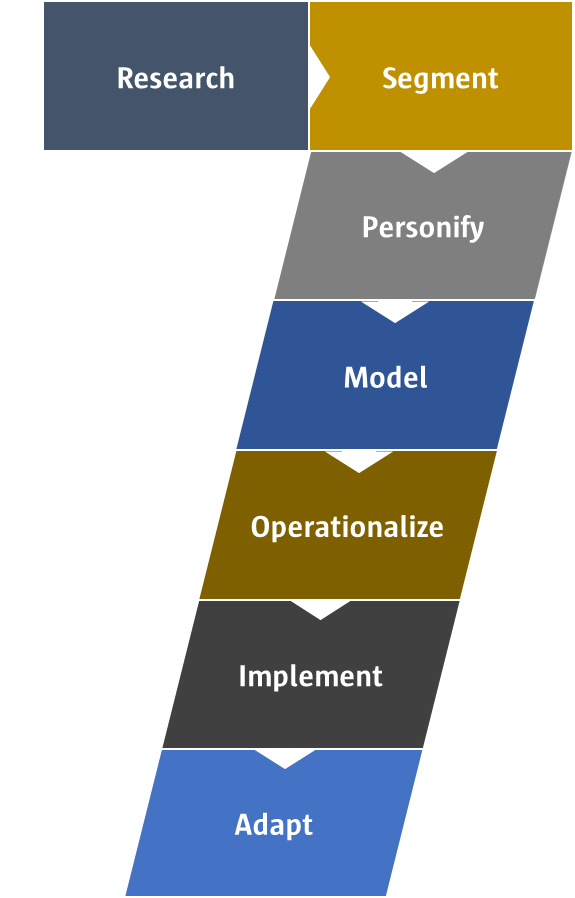
Seven steps of research amarketing

Seven steps will ultimately capture the attentions of people in the relevant segments and persuade them to engage. If you’ve been a regular reader of our blog, they’ll sound familiar. They’re essentially the same steps non-profits should be taking in marketing to donors. We’re simply applying them in another context and adapting them to achieve a different set of outcomes. Just as with RM-based donor outreach, marketing should take the lead, and executives need to stay in the loop to increase access, improve programs, etc. The steps are:


1. Researching—First, marketers need to collect information about the eligible population. Prospect research involves quantitative data, particularly statistics and trends related to demographics, economics, and geographical distribution from the US Census and similar sources. This data is supplemented by qualitative information that identifies individuals’ needs and wants, barriers, preferences, influencers, etc., which requires getting out into the community. We suggest using community surveys, followed up with listening sessions. 

2. Segmenting—Defining key groups is foundational to RM, providing the ability to tailor marketing approaches. Unless non-profits only cater to particular demographics, eligible populations aren’t monolithic. Analysis of the information from research will enables marketers to find segments, based on factors such as race, ethnicity, age, sex, income levels, geography, etc. Correctly identified, segments should have common attributes, e.g., awareness, obstacles, information sources, media preferences, and who members trust.


3. Personifying—No, it’s not possible to have a coffee with every prospective client to explain why they should take advantage of a non-profit’s services. However, marketers can develop profiles of typical people in the key segments, putting faces, names, and stories to the data and bringing it to life. Personas help marketers remember they’re dealing with real people, and make it easier to understand when to communicate, what to say, and how to express messages. They also help organizations increase access and improve experiences.


4. Modeling—Non-profits need to guide people on their journeys from prospects to clients to advocates. Building and activating relationships is a process—sometimes an extended one. The task is to keep things going forward. Journey maps help visualize how individuals will typically progress, including their knowledge, emotions, behaviors, and “off ramps.” This enables organizations to build responsive marketing plans and proactively intervene at critical milestones to ensure people stay on the desired path.


5. Operationalizing—At this point, non-profits should be ready to create strategies and tactical plans contact, interest, and convert target audiences into clients. There will be things to do at each stage of their journeys, such as defining messages, determining the right media, and deciding on placements to lead people and overcome their barriers. With limited budgets, prioritizing groups will also be important, as organizations will likely need to make choices about where to focus available resources for the greatest impacts.


6. Implementing—This involves content creation, media development, distribution, etc. It’s also important to keep in mind that ultimately, it’s the entire experience that will determine if and how a person engages with a non-profit, e.g., seeking more information, coming for help, and giving positive testimony to peers. Marketing is key, but non-profits also have to deliver on their promises, from provider attitudes and privacy assurances to ease of use and program efficacy. It’s on organizations to back up marketing’s assertions.


7. Adapting—Lastly, non-profits have to monitor and adjust to the results of their efforts. The amount of data available today is staggering—there are no excuses for continuing approaches that aren’t working! Data analytics allows organizations to identify key points at which people aren’t following calls to action. Using the journey map can help pinpoint why, whether it’s the message, media, presentation, or some other issue. There’s often some trial and error—if something’s ineffective, it’s time to change content or tactics.


RM takes time and effort, but it’s well spent if you’re a non-profit seeking to increase your impact by helping more people in need. If you’re not employing it now, it’s quite likely more effective and efficient than what you’re currently doing. If you’ve read our last two posts and still aren’t quite convinced it works, though, you can read a real-life story about how a non-profit successfully employed RM to bring in people from groups that had been difficult to reach and persuade. Come back next week for our final on this topic next—we’ve got a great example!


What You Can Do Right Now


A red stamp that reads 'take action'

You don’t have to wait for our example to get the ball rolling toward expanding your client base. We suggest three things if you’re interested in taking an RM approach:


  • Talk to the “base”—You can start by asking current clients about their experiences. What were their challenges and concerns? What happened that made them overcome them? You can ask for confidential feedback (e.g., feedback cards) when they’re in for help, and even informal discussions can give insights into how to reach more people like them.


  • Get help to go forward—We might be a little biased here, but this is a lot for non-profits to take on. Many are already overloaded, and RM takes skills marketers aren’t always confident they have. At the least, there are trainings and supporting tools available. If you don’t have the time or resources, qualified consultants can help drive the process.   


  • Find out more—We’re happy to talk to you more about RM, how it can help expand your clientele, and how to go about the process. Snowflake offers a free one-hour consultation just for this reason, and we’ll pass along resources that will give you a better idea of what to do. Don’t worry—there are no expectations or obligations associated with this!

We have a few humble requests for our readers. Please:


  • Read our last post to learn why Relationship Marketing is essential to grow your non-profit's client base. And, check out our video tutorial on the process.


  • Liberally share this post with your colleagues and peers, your Executive Directors, your Marketing professionals, etc. (see links up top)


  • Give us your feedback on this post and any others on The Snowbank, including your thoughts, experiences with the topic at hand, etc.


  • If you have questions or just can’t wait to get going to serve more people in need, please contact us by clicking on the button below and we'll set up some time to talk
Get in Touch ›

Share Post


Read Other Posts

People collaborating around laptops at a bright office table with papers, coffee, and plants.
By Snowflake Consulting August 25, 2026
We see startups with so many layers of leadership it’s almost absurd. What possible reason is there to hire an experienced Director, only to bury her in bureaucracy?
Hand holding a glowing water droplet icon over digital circuit graphics
By Snowflake Consulting August 21, 2026
The water workforce is aging, and young talent is not arriving quickly to close impending gaps. Finding ways to get needed skills for future demands is critical.
Autumn forest with a forked dirt path and yellow-orange trees
By Tom Morley August 19, 2026
Gain insights on resilience & support from a consultant's journey through family crisis. Contact us for guidance today!
Smiling Black woman with short silver hair in a white shirt at an office desk.
By Millree Williams September 12, 2025
Learn how mature job seekers can leverage their experience and skills to thrive in the job market. Start showcasing your value today!
Woman in glasses sits at a desk in front of a laptop, hands clasped, looking at the screen.
By Snowflake Consulting September 4, 2025
Everything beneficial about hiring for key roles starts with abandoning the assumption that "older" means "less relevant" in today's world. It's simply not true. The companies that abandon their preconceptions are the ones that will succeed in the future.
A partially submerged iceberg peeks through the top of the water
By Rachel Marvin - Fellow, Marketing April 12, 2024
Identify root causes of performance issues. Use Root Cause Analysis for sustainable solutions. Contact us for expert consulting!
People collaborating around laptops at a bright office table with papers, coffee, and plants.
By Snowflake Consulting August 25, 2026
We see startups with so many layers of leadership it’s almost absurd. What possible reason is there to hire an experienced Director, only to bury her in bureaucracy?
Hand holding a glowing water droplet icon over digital circuit graphics
By Snowflake Consulting August 21, 2026
The water workforce is aging, and young talent is not arriving quickly to close impending gaps. Finding ways to get needed skills for future demands is critical.
Autumn forest with a forked dirt path and yellow-orange trees
By Tom Morley August 19, 2026
Gain insights on resilience & support from a consultant's journey through family crisis. Contact us for guidance today!
Smiling Black woman with short silver hair in a white shirt at an office desk.
By Millree Williams September 12, 2025
Learn how mature job seekers can leverage their experience and skills to thrive in the job market. Start showcasing your value today!
Woman in glasses sits at a desk in front of a laptop, hands clasped, looking at the screen.
By Snowflake Consulting September 4, 2025
Everything beneficial about hiring for key roles starts with abandoning the assumption that "older" means "less relevant" in today's world. It's simply not true. The companies that abandon their preconceptions are the ones that will succeed in the future.
A partially submerged iceberg peeks through the top of the water
By Rachel Marvin - Fellow, Marketing April 12, 2024
Identify root causes of performance issues. Use Root Cause Analysis for sustainable solutions. Contact us for expert consulting!
People collaborating around laptops at a bright office table with papers, coffee, and plants.
By Snowflake Consulting August 25, 2026
We see startups with so many layers of leadership it’s almost absurd. What possible reason is there to hire an experienced Director, only to bury her in bureaucracy?
Hand holding a glowing water droplet icon over digital circuit graphics
By Snowflake Consulting August 21, 2026
The water workforce is aging, and young talent is not arriving quickly to close impending gaps. Finding ways to get needed skills for future demands is critical.
Autumn forest with a forked dirt path and yellow-orange trees
By Tom Morley August 19, 2026
Gain insights on resilience & support from a consultant's journey through family crisis. Contact us for guidance today!
Smiling Black woman with short silver hair in a white shirt at an office desk.
By Millree Williams September 12, 2025
Learn how mature job seekers can leverage their experience and skills to thrive in the job market. Start showcasing your value today!
Woman in glasses sits at a desk in front of a laptop, hands clasped, looking at the screen.
By Snowflake Consulting September 4, 2025
Everything beneficial about hiring for key roles starts with abandoning the assumption that "older" means "less relevant" in today's world. It's simply not true. The companies that abandon their preconceptions are the ones that will succeed in the future.
A partially submerged iceberg peeks through the top of the water
By Rachel Marvin - Fellow, Marketing April 12, 2024
Identify root causes of performance issues. Use Root Cause Analysis for sustainable solutions. Contact us for expert consulting!